Showing posts with label self-improvement. Show all posts

Thursday, January 22, 2009

On answering the call to serve.

During his campaign for president, Barack Obama asked the American people to give of themselves to help steer us out of this national funk we're in. Service, he said, helps us help our fellow citizens, lifts our spirits, benefits the economy, and fosters a sense of responsibility in America's destiny.

I didn't need to be told that by President Obama. The benefits of service and altruism, to me, are self-evident. But that's not the case with a lot of Americans. Many are complacent enough to let others do the serving, while they reap the benefits of a prosperous country.

What happens, then, when your country isn't so prosperous? Is it then time to get off your duff and do something worthwhile?

It's a shame it's come to this, but if an economic downturn, and a "sapping of confidence across our land," are what's needed to get Americans mobilized, then so be it. Let them take a share in country's future - as they should have all along.

Obama used Martin Luther King, Jr. Day as a call to arms for all Americans: do something above and beyond yourself. Use Dr. King's legacy to serve the underserved. A lot of Americans answered the call.

But I imagine more didn't. And no matter how many times the president asks us to serve, there will be those who seek excuses for not serving. I'll bet some won't even be shy about it.

During the last administration, the most Bush asked us to do was to grab our credit cards, start shopping, and shut the damn up about Constitutional abuses. We were asked to give nothing up in response to the Afghanistan and Iraq War, except the lives of our young people and our standing in the world. We sacrificed little. Maybe that's why the cries for the war to end have been relatively quiet. Why cry when you have little to cry about?

Now a lot of people are hurting, and perhaps Obama's message - that we're in this together, that it will take a collective effort to get us out of this mess - will be respected. There's plenty of blame to go around, but a heart attack patient doesn't weep long over the pizza and beer of a previous life. Instead, he gets busy shaping up. That's what America needs.

One of my online/Mac/humor heroes, Merlin Mann, said it well:
Maybe what we really need is somebody to tell us it’s time to grow up, to think about how the rest of the world operates, and to accept that being a country of adults means doing a ton of insanely hard work and making sacrifices where not everybody wins.


So what to do? How can each of us assist in beating the "general malaise," as President Carter once understood it, and fight the "crisis in confidence?"

The options are endless, really, and it depends on where your heart find the most joy. Marketer Seth Godin has a few ideas, and some ideas are very difficult at all. You could do as the Coudal Partners suggest and simply put your hard-earned money where your mouth is. Do you seek confidence in the strength of the American market? Fine. Pay up or shut up.

Chances are, however, that your efforts can do the most good not too far from where you're sitting right now. Time and time again, I talk to local non-profits and businesses and hear the need in their voices: shop here, give here, help us out.

My advice? Go where your talents can do the most good. Or, go and do something that you've never done before. Just do something. Not all of us can be Ben Franklin, who gave so much of his time, talent, and attention that we put him - a guy who never became president - on our currency. But you don't need to be Ben Franklin to make a different somewhere. Try this: one night a week, for an hour or two, give your time to a cause you care about. Just one night a week, turn off the TV, set your video game down, get out of your living room, and put yourself to work - for free - on a project.

If you do this already, great. Your country thanks you. Keep doing it, and do a bit more if you can afford to.

But if you don't usually do this kind of thing, and even if you didn't vote for or support President Obama, answer his call to service. If you don't, nothing will happen. No one will hate you. America will carry on as before.

And that's exactly what I'm afraid of.

Tuesday, April 8, 2008

Look what I found...

Another version of myself. From 2003-2004.

Hot damn. Nothing like cringing at your former self.

Sunday, March 30, 2008

On taking inventory.


Even before I interviewed a local sheriff deputy about his house burning down, and asked what our credit union could do to help his family out, I knew a complete listing of everything I owned was a good idea.

After all, fires happen all the time. I’ve already had valuables stolen from my car. And shucks, zombies could take over any day now.

So I decided that March would be "taking stock" month, a sort of spring cleaning that put all my material possessions in order, taking photos of everything I owned, and keeping information like serial numbers and replacement costs in a handy spreadsheet should disaster strike. Little did I know how much work it would entail.

But it’s all been supremely worth it.


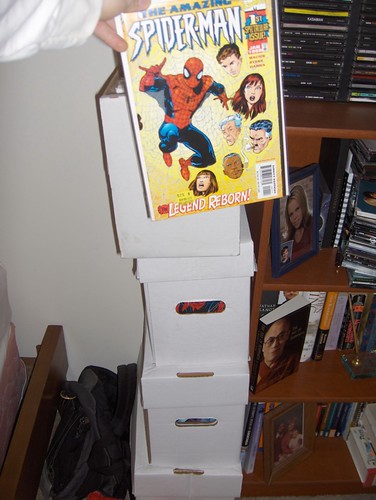
Little did I know, for instance, that my comic collection includes almost 800 comics worth more than $3,200. Just my Spider-Man collection clocks in at $1,500, give or take a few hundred. It took a day in a half, with some online help, to figure all that out.

Few things scare me more than the thought of someone breaking in to our apartment and making off with one of my Macs. While it’s true that I lock my Apples down with enough passwords to make Fort Knox jealous, and I do a decent enough job of backing up all my data with external hard drives, but still.

What’s funny is that, if you take my comic collection, it’s worth more in ashes than it is sitting in the five or six boxes that store them. People aren’t willing to pay a good price for the latest edition of "Ultimate X-Men," but if they all burned up my insurance company would have to give me top dollar for them.


Everything I have is worth something. It’s hard for me to guess what the exact values are, but I’ve read that as long as you keep some sort of record, you’ll be paid back if disaster strikes.

Part of this project has involved cleaning and gutting as well. I have magazine subscriptions that date back years, and some of the issues I’ll never even look at again. Into the recycling bin they go.

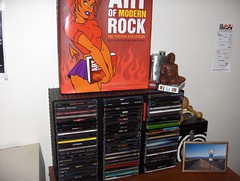
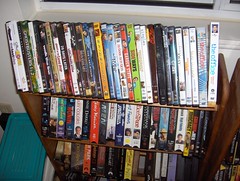
All of this will be documented in spreadsheets, photos, iTunes lists, and burned onto a CD that will be kept off-site. After all, it doesn’t make sense to keep an inventory if the inventory melts in the flames with everything else, right?

So here’s my advice: if you have things you value, and they’re not all indestructible, take the time and effort and document everything. Everything. Stand in each room, even, and take a general "here’s-this-side" photo, just in case you forget anything.

Photos, quilts, childhood toys - those you can’t replace. But no sense in watching everything go up in smoke. We’re not all Superman, and we can’t keep everything in the Fortress of Solitude.

It’s called CYA - which means "Cover Your Assets" or something like that. There’s no better time to take stock than now.

Thursday, October 18, 2007

On improvement.


Self-improvement has a long history in this country. Ever since Ben Franklin started working under a pseudonym, America has long been the center of the self-help crowd. What other country, in the minds of people around the world, offers the kind of start-all-over paradigm that we do?

Hell, even the pilgrims knew they could start fresh somewhere else.

Maybe I was born in the wrong era, because - looking back - my life has been one big self-improvement saga. From awakening my thirst for involvement in high school, to my participation in activism and leadership at college, to my community awareness in the working world, it seems I've always strived to do more - and better.

Consider a few things I've been working on lately:

Running
At the start of the summer I couldn't run for two continuous minutes. Now I can run a 5k. I tried out track in high school just so I could know what being involved in varsity athletics was like. And I was decently fast. These days I'm doing it just to say I can do it. The fun part? I have something else to talk to people about.

Financial peace
This one is ongoing. I've had a decent handle on my finances since graduation, but now it's a goal, and a project, and something I'm working toward improving. It doesn't involve just making more money, but doing more with the amount you have. I've learned so much.

Web site design
This is the one area where I'm lacking in graphic design, so lately I've decided to do something about it. With the web becoming so integral to business and organizations, it's silly not to learn the basic. Now I'm helping build web sites for work, Rotary, Recycling, and Katie's dad's business. I want to take a class at Jackson Community College to learn more. Why not?

Mindfulness
I got turned on to a few meditation podcasts after reading an article in National Geographic that said Buddhist monks were, according to pure numbers, the happiest people on Earth. I wanted some of that, and started experimenting. Turns out, it's not that bad. My heart wasn't built for organized religion (probably because I tend to ask too many questions), which is probably why I've always been interested - or at least curious - in Buddhism. The best part is you don't even have to be a religious person to reap the benefits of meditation and mindfulness. Maybe we could all use a bit more quiet time.

GTD
This one's also almost always ongoing, but I'm always trying to get more done in the time I have. I started carrying around a thumb drive, and on it I have plain text to-do lists, listing my projects, ideas, and even a grocery list. I found a neat notebook I can carry in my car, in case I think of something at red lights. And the ol' note-on-the-back-of-my-hand trick works everytime. If it's not written down, it doesn't get done, so you'll find scraps of paper everywhere I am. All to GTD.


...and I've always been this way. From picking up a guitar to running for student government president to start a recycling program here at work - life is too much fun to passively watch it go by.

But what does it all lead to? Where am I going with all this?

Lately I've thought about the ultimate start-over technique: moving/working somewhere else. On all my trips over the past few years, I've explored each spot as a possible place to live and work. Not in any definite amount of time, but just to plant the idea. Over time I've learned where I wouldn't want to live, and where it might be kind of fun.

Shucks, with the country headed in the direction it's in, I've always thought of moving to that northern neighbor right over our heads.

Maybe all this self-improvement stuff is a type of monomania. Is the constant need for a better me a good thing, or even healthy?

Always, there's a burning in my stomach to try more, do more, live more, get more done. A lot of it is not even feasible, but then the only big expectations I have are for myself. I hope that, given any situation, I'd make the most of it. I'd probably have a lot of fun, too.

What's next? Who knows. But it'll be something. Maybe I'll land on my next big project by chance, but I'm starting to think that spending some time researching my big ideas might be the way to go. Go back to school? Live somewhere else? Run for office?

Poor Richard was right when he said, "Tis easy to see, hard to foresee."

But I do know a better me is within sight.

Thursday, April 19, 2007

Busy is as busy does


Having too much to do can be a curse.

It's been like this ever since I can remember (which stretches about as far as freshman year of college): to-do lists, notes written on my hand, stacks of paper, unresponded-to e-mails. It all adds up to one big pile of busyness.

Just ask anyone who's e-mailed me. When's the last time you heard from me right away, especially if you need something done? My tendency is to receive the e-mail, read it briefly, then let it sit in my inbox for, what? Days? A week? Then, when I realize the pile that's buildling up, I plow through each message and tackle the project in a fury of productiveness.

On a good day, that is.

But lately I think I'm hitting some kind of stride. Especially when it comes to Rotary and Recycling; the projects I'm working on have actually been getting done.

My trick? Keeping an electronic to-do list on my flash drive. Every day I plug it into my computer, read the lineup for the day, and try to spend a few minutes working on whatever needs working on. Just a plain ol' text file is all I need.

E-mail? That's getting better, too. I subscribe to the zero-inbox philosophy; there's something about an empty inbox that screams "aaaahhhhh." So making sure I hit e-mails as they come in, or at least flag them for some kind of response later, becomes key. Luckily, Gmail makes it pretty easy for me with the neat little "star" feature. If I need to respond to something, or someone needs something from me, I "star" the e-mail and that lets me know I need to get to it eventually.

Google, thankfully, has been helping as well. Have you checked out all the non-search stuff Google has been up to lately? Did you know you can personalize your Google homepage to give you your Gmail inbox, your calendar, local gas prices, the weather, and - a must for me - late-breaking headlines?

And sweet Jesus, take a look at Google Maps or Earth. I'm in the process of marking down every place I've ever been in this country. For free.

Tonight I even made a web site for my Rotary club. It's simple, but it works for our non-technical group.

The trouble with all this is it can quickly become a soft addiction. I could spend hours logging all the trips I've made on Google maps, and for what? Just to show off? For me it's like a scrapbook of Places I've Been, but it can be a big-time time waster.

And now I've got a bunch of big trips and plans in the next month - weddings, conferences, a giant trip cross-country to Seattle - that will be taking up more of my time. Who needs sleep?

It seems like a have a decent system down. iCal at home, Outlook at work (with those life-saving pop-up reminders), calendar on my iPod, and a scribbled-on hand that goes wherever I do - it's a recipe for Getting Things Done.

I've written before the benefits of slowing down, counting the breath, and not devoting one's life to GTD, but the habit is hard to break.

Life always happens in the meantime, doesn't it?

Tuesday, February 6, 2007

On being too busy

"Do few things and do them well." - St. Francis


Busy people recognize busy-ness. In conversation, we can connect with our compatriots.

"I've got a meeting tonight, and I have to run and do some errands, but later if you want to we could..."

In between all that, a busy person will recognize his or her own situation. "Yeah," they might think, "I know how that goes."

But, like most of a busy person's relationships, that may be all we glean from the encounter. It may be that appointments and engagements takes the other person away, or perhaps your own busy-ness carries you off. For what can be learned of our friends and family if there's no time to learn it?

Thomas de Zengotita, in his book "Mediated: How the Media Shapes Your World and the Way You Live In It," likens this skimming to the feeling you get when a limb - arm, leg, foot, whichever - falls asleep. "Ever notice," he writes, "how, when your hand is numb, everything feels thin?"

Sure, anyone can relate to that. Zengotita says this can be read as a "guiding metaphor" for the "mediated adult" - being someone who is so "busy" being an adult, with all its activities and responsibilities, that life tends to feel a bit thin. Or maybe we don't feel it at all. We're so used to that thinness that we think life should feel this way.

Only when "the ultimately real descends upon us in the form of tragic accident" does that haze lift - sometimes, only briefly. "And then," Zengotita goes on, "we remark upon how things have been put in perspective."

Like a stone skimming a pond, we merely tread the surface. We tip-toe on only the tip of the iceberg. In both, we never truly get wet.

Unless disaster strikes.

I can certainly relate. I remember there were times, in college, when I would have an entire day's worth of activities and to-dos planned that only at the end of the day could I really sit down, relax, maybe get some homework done. Things haven't improved all that much. I'm still involved in many organizations, have friends in town and out to visit and socialize with, have hobbies to maintain, and somewhere in there I eat and sleep. Then get up and go to work. Over and over again.

Life is fleeting. It's fleeting because I'm so busy doing the flying.

Lately, though, I've been stepping back and taking a look at how I do things. Instead of running all over hell's half acre, I make a point of setting aside a few nights for relaxing, or doing things with friends, or just doing nothing at all. I'm selfish with my time. And why shouldn't I be? It's one of those things you can never get back, no matter how much you multitask.

Multitasking, in fact, can be held accountable for some of our busy-ness. Even on the ride home from work, you can call friends or family, set up your schedule for the rest of the night, maybe do a few errands why you're out and about. So busy. With cell phones, PDAs, etc., technology has its stake in this, too.

We probably never set life on cruise control as we do now. Now, we just let the engine of busy-dom jet along at an ever-faster pace. Meanwhile, our relationship with our actual lives begin to thin at the margins.

Ever notice how life seemed so much slower "back then?" Perhaps it was because there was less to do, but also because people didn't feel the compulsion to cram their day with the day-to-day. Long conversations, extended meals, walks and community events - these are what filled people's time. It was quality, not quantity.

Saint Francis understood this. His words tell us that a person's life can be truly fulfilled only when mastery of a few key ideas, skills, or accomplishments are realized. Today's world is filled with so many choices (think about the cereal aisle at the grocery store) that to land on and master any one thing become difficult. Why do a few things well when you can do all sorts of things half-assed?

But Tom Hodgkinson, in his book "How to be Idle," says that being busy robs us of the very things that make us human: thought and self reflection. How can we get to know ourselves, he argues, when we're too busy to stop and think?

He even quotes Oscar Wilde, from Wilde's essay "The Critic as Artist":

The contemplative life, the life that has for its aim not doing but being, and not being, merely, but becoming - this is what the critical spirit can give us.

In other words, a "to-do" list (which I swear by, I'll admit) keeps us from finding ourselves. It's all a distraction. Amidst so much to do, we have forgotten what matters. And - back to that "thinness" metaphor again - we eventually become superficial beings, instead of the realized versions of a potential self.

While playing video game football hardly helps me realize my potential self (accept, perhaps, when I can beat Don), it helps me settle, helps me use my brain, and helps me relax.

It's also one of the reasons I've found Buddhism so attractive lately. I don't have a religious bone in my body, but something about the practical aspects of mindfulness, and concentration, and just sitting and thinking - it's awfully hard to ignore the benefits. Instead of being so worried about planning, or regretting, or being anxious about things I can't control, I simply let them be. It's a fine art, and a talent, and I hope I can develop it more.

For some, however, being busy is all they know how to do. Running on all six cylinders is the usual - only on vacations or when they're asleep do they know the meaning of "down time." In the meantime, there is this drive to get things done. Perhaps, when the too-busy person looks back at their life, they will feel a sense of accomplishment.

But at what cost?

I think you can have it both ways. You can do lots of things - strike off those items on the to-do list, one by one - but still keep a sense of connectiveness to those you care about. It's about moderation. And (here's a multitasker's buzz-word) time management. Shucks, even a day spent on the couch, watching a movie, being lazy - it can be beneficial. Running on overdrive has to have its cost, emotionally, spiritually, mentally, and certainly physically.

And when it does, what will all that running around be worth?

Wednesday, December 6, 2006

The road to self-improvement


Home sick today, after having my top two wisdom teeth pulled out. The experience wasn't a fun one (I nearly ripped the dentist chair's arms off during the procedure), but it had to be done. So this morning I woke up to a bloody pillow, a sour feeling in my stomach, and two less teeth. Joy.

But I did manage to attend my final Financial Peace University Class last night with Suzanne, ending a 13-week long session of self-discovery and budgeting education.

Suzanne's boss paid for her to take the class, and since you're supposed to take it with a spouse - and she didn't have one - she invited me to attend with her. I was pretty skeptical at first. I was thinking it was another one of those get-rich-quick schemes; you know, buying or selling crap, real estate scams, etc.

Now, however, I'm so glad Suzanne invited me. The class has been one of those experiences where you wonder how you ever got along with out it.

Not that I've ever had big problems financially. I've always been pretty responsible, especially since leaving school. Except when it comes to debt, in which case I thought everyone gets in debt while they're at school. Right? Who doesn't have a student loan or a credit card these days?

"The borrower is slave to the lender," Dave Ramsey says, a quote he took from the Bible. Ramsey is the one who instructs the class (via a DVD series we watched at a local breakfast place, every Tuesday night). If you haven't heard of Dave Ramsey (he's got a pretty popular radio show), I suggest you check him out. At times he can be arrogant and tough, but he knows what he's talking about.

His motive is simple: get out of debt so you can use the money you're currently paying to credit card companies to build actual wealth.

And use financial methods our grandparents used. Not so much a can filled with cash on top of the refrigerator (or in the freezer, as my grandpa used to do), but building an emergency fund for those sure-to-come events in life, or buying things with cash and bargaining when the situation fits.

The plan involves baby steps and debt snowballs and all kind of neat (but truly legitimate) tricks to get yourself out of debt. Just the other week I paid off a credit card I've had since college. I even over-paid, so they have to send me a check for the remaining balance. And I'm going to frame that check to document the first time a debt-causing business has ever owed me money. It's a pretty good feeling.

Next will come a few other credit cards I've had, then paying off my vehicle early, then my student loans, and so on. I like the thought of not owing anyone any money, and I really like the thought of the house I could buy with all those saved payments. Imagine what you could do if you didn't have any student loan or credit card payments. I've already started imagining.

The whole thing has been a blast. I've started selling a lot of my crap on eBay, and I'm doing pretty well. With the money I've raised, I can hammer away at my debts. The program also includes budgeting, which I've always strangely enjoyed, and I'm finding that I'm spending less and saving more. That may mean I'm the designated driver a few more nights a month, but I have plenty of fun with the money I have.

Last night we had a nice potluck and handed out "graduation" certificates, but the over-arching theme of the night was people breathing a collective sigh of relief. This stuff should be taught at the high school level, before the credit card companies get to you, but we were all glad we learned it now. Better late than never.

I've also met a few new friends, and found out that just about everyone has money problems of some sort. The trick is, as Dave says, to manage your money - not let it manage you.

So off I go. Ready to pay off another credit card probably by the new year, and then another, and then I can use all the money I was making payment with to make bigger payments on the stuff that's left. It's brilliant. And I can't wait to be debt-free.

Dave Ramsey encourages the class to take the knowledge and spread it to others (free of charge!). I think that I'll save up and buy my dad a spot in the next class, because I know he's never been great with money.

It's probably the best gift I could give him.