Showing posts with label environment. Show all posts

Thursday, February 28, 2008

Defending Apple's environmental record.


Giving all the guff that Apple has received lately about becoming more "green," it's no surprise that Apple would want to protect its reputation - especially considering it was founded by two liberals in Northern California.

I opened my shareholder meeting proxy vote ballot several weeks ago and found this little gem as one of the voting items:
TO CONSIDER A SHAREHOLDER PROPOSAL ENTITLED "AMEND CORPORATE BYLAWS ESTABLISHING A BOARD COMMITTEE ON SUSTAINABILITY", IF PROPERLY PRESENTED AT THE MEETING.
Could this be the work of board member Al Gore? Or pressure from groups like Greenpeace? Or maybe it's just Apple finally getting serious about recycling and sustainability.

Just how green is Apple? Before Greenpeace launched its campaign against Apple, highlighted by its mock apple.com site (that asks "We love our iPods, but can we lose the iWaste?"), Apple was phasing out production of lead-balloon CRT monitors beginning with the iMac G4. And according to Apple, the "greening" began ten years earlier:
Apple started recycling in 1994 and today we operate recycling programs in countries where more than 82% of all Macs and iPods are sold. By the end of this year, that figure will increase to 93%. Apple recycled 13 million pounds of e-waste in 2006, which is equal to 9.5% of the weight of all products Apple sold seven years earlier. We expect this percentage to grow to 13% in 2007, and to 20% in 2008. By 2010, we forecast recycling 19 million pounds of e-waste per year — nearly 30% of the product weight we sold seven years earlier.
Right. And just recently, Steve Jobs bragged about the MacBook Air's environmental laurels onstage at Macworld. Its LCD is mercury- and arsenic-free. The circuitry is PVC free, and Apple plans to "completely eliminate the use of polyvinyl chloride (PVC), brominated flame retardants (BFRs), and arsenic in its products by the end of 2008," according to its website.

Plus, as you can see from these pictures, the packaging is much smaller and more efficient than other Apple laptops - by almost half. Even the aluminum laptop enclosure can be recycled.

Like they did when the new iPod packaging was released in 2006, Apple was quick to mention that smaller packaging helps the environment by using less resources to haul cross-country.

(You can also use iPod packaging in more inventive ways - see here)

You can even recycle your iPod or a cell phone from any manufacturer. Apple includes the shipping label for you, so it doesn't cost a dime. Now that's cool.

What seems to plague Apple, a founding member of the US EPA ENERGY STAR program, is its lack of bragging. The company is known to be tight-lipped, on everything from new product launches to goings-on at its corporate headquarters, and when the company does brag, it's usually about usability breakthroughs and life-changing inventions. Here's an example: did you know Apple has a partnership with its hometown, Cupertino, CA, to recycle electronics free of charge? It doesn't even have to be an Apple product. They've been doing it since 2002.

Apple has used the same materials other computer makers use, but as the green tidal wave grew in strength, it quietly went about its business. Granted, pressure from the sustainability community has quickened Apple's pace in phasing out harmful chemicals and implementing take-back programs, but my feeling is the company would have reached its public "greeniness" eventually. It would've had to: Al Gore is a board member, remember?

Now Steve Jobs makes a point to bring up Apple's greening at every major public event. Never mind that they've been winning waste management awards as far back as eight years ago.

But any visitor to sites like Low End Mac, or even our own Newton community, knows that Macs have an incredibly long lifespan. People still use Mac SEs and Quadras for everyday use, seeing nothing wrong with running OS 8 and Netscape to do all their work. Browse eBay sometime and see what "obsolete" iMac G3s go for. Shucks, I've been craving an iMac G4 for a while now, and am still waiting for the price to come down low enough so I can snatch one.

Mac users hold onto their computers, or sell them so someone else can use them. Can you say that about a 1997-era Dell? Do you see kids lining up for 30,000 used HP laptops, priced at $48 a piece, like they do for iBooks?

I've experienced, first-hand, the type of recycling Apple users utilize: at a recent e-waste drive for my recycling group, a man dropped off an Apple IIc (which some folks still use as a gaming platform). Once I saw a Mac SE/30, and another time someone dropped a PowerBook 5300. In other words, it takes years for Apple users to finally say, "Okay, I've had this long enough, and don't use it day-to-day. Time to recycle." Is anyone going to recycle a used PowerBook G4? No. Never. It's going on eBay, and it's fetching several hundred dollars at auction's end. Used iBook G4s still go for almost as much as a brand new MacBook.

Take Newton users. Here is a dead-and-gone, by Apple's standards, product, and yet ten years after the last MessagePad came out the community is as big and as vibrant as ever. The iPhone has come and gone, and Newton users are still trading and swapping and modding their green-lit hearts out.

That's how Apple fans recycle their computers. They either keep using them, give them away, or sell them. Or tinker. Or upgrade. Or...

That doesn't mean Apple should slack in the recycling department. E-waste is a scary and growing problem, in this country and especially the third world, and Apple would be smart to keep its name out of that quagmire altogether. Apple has enough problems fending off criticism for its sweat-shop labor practices.

Dell teamed up with Goodwill to recycle old computers in my state (Michigan), and several others, which was a smart way to get its name out there in the fight against e-waste. Maybe Apple would want to do something similar: attach its name to a big program, and reap the PR benefits.

Maybe that's what this whole board committee on sustainability is about. Apple sees the growing awareness for environmentalism, and - if the board is smart - wants to do the right thing by its mostly-liberal fanbase.

Because that's the name of the game here. Apple, as a responsible and influential company, should be doing the right thing. Recycling and environmentally-friendly products help in the quest.

But in quiet ways, Apple (and Apple fans) has been doing some of this right along.

Tuesday, August 14, 2007

Thirsting for plastic.


Water is expensive.

This according to a New York Times column (Aug. 1, 2007) that pointed out if you got your eight glasses a day from bottled water, you could spend $1,400 every year. Compare that with the $0.49 it would cost from plain old tap water.

Consider this: all that plastic costs barrels of oil. All those bottles cost money and CO2 to ship cross-country. Only 23 percent of bottles are recycled, and states like Michigan don't offer a deposit as an incentive.

Recycling Jackson has reported on the thirst (pun intended) for recyclable plastics: companies can't collect enough used plastic bottles, even though the demand is high. Companies are willing to pay decent money for someone's used Aquafina (which is tap water anyway) bottle.

Plastic bags, however, are a totally different story. They're a pain in the ass, according to a Salon.com story about the difficulties of recycling the jelly-fish like bags:

"Every year, Americans throw away some 100 billion plastic bags after they've been used to transport a prescription home from the drugstore or a quart of milk from the grocery store. It's equivalent to dumping nearly 12 million barrels of oil," writes Katharine Mieszkowski.


Only one percent of those are recycled.

Some have said plastic is better than paper, but you can't grow more oil like you can more trees. "The only salient answer to paper or plastic is neither," says the article.

When I attended a Mariner's game during a recent Seattle, WA trip, I noticed that everywhere I looked there were bins for recycling plastic pop, juice, water, and - yes - beer bottles. And when the game was over (they lost to Texas by one point), the announcer even reminded the audience about the recycling bins.

What do Seattle Mariner fans know that we don't?

I'll admit: I'm a fan of bottled water. It tastes good, it's portable, and I can make a health and wellness justification when I bypass the sugared soda pop for a liter of the clear stuff.

But paying $1 or more for a bottle of the same stuff I flush in my toilet seems absurd, doesn't it? This is the same stuff I use to clean my dishes, wash my car, and brush my teeth. And it's still the safest and cleanest in the world. Some parched countries in the Sahara would give a lot for a teaspoon full of what I watch go down the drain every morning.

So recently I've started drinking plain tap water. And you know what? It's not that bad. I add a few drops of lemon juice if I don't like the taste, plop in a few ice cubes, and away I go. I'm not any less satisfied. My thirst is just as quenched, and I didn't contribute any more plastic molecules that will be around longer than the cockroach.

The critique is two-fold, involving both the use and waste of plastics and the mania behind obtaining fresh water from somewhere besides the garden hose. The more you think about it the more ridiculous it seems.

All that craziness has me thirsty. Time to grab a glass of cool, clear...

Well, you know the rest.

Monday, July 30, 2007

eJunkies anonymous.


I've made a big step in my life. One that has involved plenty of thoughtful analysis and probing soul-searching. It's nothing to be taken lightly. I have to do what's best for me.

I purchased compact fluorescent light bulbs.

Because I have to do what's best for the environment, too, and when I learned that most of a incandescent bulb's energy is lost to heat - and how I could save money on my electric bill - it just made sense. It's not often you'll get a household item that will pay for itself over time.

The deep, deep discount on Amazon.com ($4.99 for four bulbs) helped a lot, too.

So now when I turn on the lights at home I know I'll be helping the environment, saving on my energy costs, and reducing my impact on Global Warming - literally. Have you ever felt a lightbulb when it's on?

I think something clicked in my brain back when we learned about recycling and Earth Day in school. All that planting trees and three-Rs just made sense. Why waste?

Katie also handed me her old cell phone to recycling (or sell on eBay - we haven't decided yet), so I sent an e-mail out at work asking for anyone's old phone so I could take it to our recycling site. I also bought and distributed recycling bins around the office - especially near the copy and fax machines - so we can reduce our paper waste.

The funny thing is all this doesn't take much work. A few half-hours a week, and you can make a little bitty impact.

Considering we're all making a great big impact on the world at large - did you know the plastic we create will never go away? - it's shameful to think some people don't do anything.

It might be that I dig the warm, squishy feeling I get when I do something like e-cycle cell phones or batteries that would have otherwise ended up in the trash. I don't look for any recognition or thanks, but it always helps when people play along.

At work, when I asked for paper grocery bags to store all our to-be-recycled paper (it makes it easier to just toss the whole thing in the recycling bin), my coworkers came through in spades.

And after I sent out the e-mail, one coworker came up and gave me a cell phone she put in her desk. She didn't know what to do with it.

Little things like leaving lights on when no one's in the room, or throwing away a blank sheet of paper and not using it for scrap, or buying those stupid disposable mops that Swiffer is so proud of - it drives. Me. Crazy.

But I'm not interested in changing everyone's mind. It's impossible. I remember Dr. Renner picking on me in the newspaper office, saying he was going to crown me "resource managment czar" because I was such a pain about reusing paper and turning off lights. And this coming from a professor who would burn through reams of paper like a junkie with pharmacy keys.

Instead, I'll quietly go about doing my own thing - like those fancy new lightbulbs - and wait for the rest of the world to come to its senses.

Thursday, October 26, 2006

Heaven is a place on earth.


If you believe you're going to heaven, what do you think it will look like?

As a kid, I remember thinking that heaven was on top of the clouds - that a walk down a street in heaven was like walking on a soft bed, and that the buildings and structure of heaven didn't vary much from where the Care Bears lived.

Maybe it's not a place at all. Some Christians believe that heaven is a state of mind, earned when you are truly saved and redeemed by Jesus Christ.

But what if it's none of the above? What if heaven is, as Belinda Carlisle sang, a place on Earth?

If so, we've sure made a fine mess of it.


- - - - -

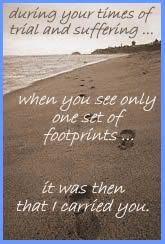
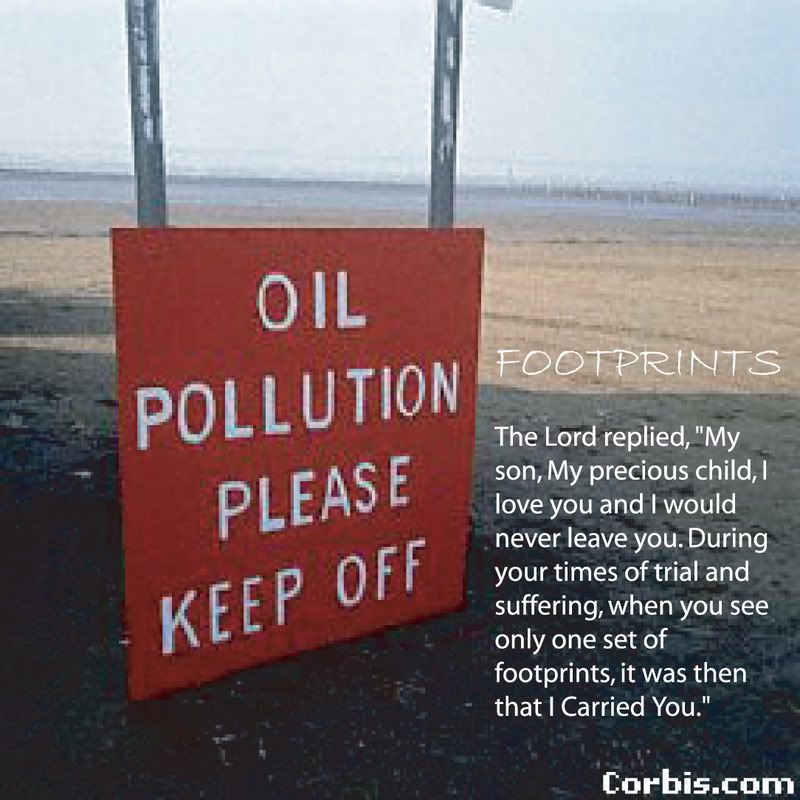
Have you ever seen that "Footprint" poem - the one where the narrator sees two sets of footprints (feetprints?) on a beach, and then only one, and it's because God was carrying the narrator at the end? Maybe it looked like this:


You see that nice beach scene the poem is placed over? You get a sense for the poem's meaning because the visual - two sets of feet along a sandy waterfront - is so immediate. Anyone who's been on a beach has seen something similar.

I got thinking about the "Footprints" poem because, recently, I've been reading about Christians embracing environmentalism as a way to display their faith in God and to show their commitment to His creation.

If God made the world, and us in his own image, what would he think about us tearing up his place?

There are some Christians who seem to think that environmentalism is some conspiracy job dreamed up by liberals, lefties, and - worse - the French. But there are even die-hards - like my favorite nutjob Pat Robertson - who are starting to come around.

On Bill Moyer's recent "On America" series, he ran a story called "Is God Green?" where he finds out what kind of Christian becomes concerned with the environment, and why other Christians think those Christians are nuts. His story takes us to West Virginia, where coal mining companies are actually leveling entire mountains to get at the black gold inside, and how that makes the water undrinkable and the citizens sicker than hell.

What would Jesus do? Would he poison the streams just to earn a buck or two?


- - - - -


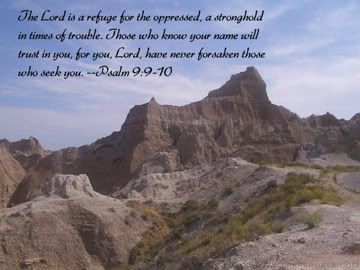
There's an entire market of Christian quotes and Bible verses that are printed on majestic scenes. Perhaps you've seen one:


They're on calendars, mugs, greeting cards - you name it. The word of God is paired with a glowing scene of beauty and splendor. And why not? His words are supposed to be uplifting and what says "you're saved" like a mountain-and-stream scene?


But if you're a Christian, and you think helping the environment is for hippies, these two messages don't jive. You wouldn't pair, say, a passage from the Psalms with a Wal*Mart parking lot scene, would you? They don't fit.

So what kind of case can a Christian make for spoiling the very creation that we're supposed to enjoy, raise our kids in, and marvel at the beauty of?

I remember Dr. Renner, in our Environmental Journalism class, saying that - when he went to church in Iowa - his preacher would say that everyone was just passing through "this mudball Earth" on the way to the true home up in heaven.

"Just passing through," Renner would joke.

And if you truly believe that, then maybe using the Earth's resources until they're all dried up makes sense. If this home is only temporary, what's wrong with a few extra parking lots?

Well, for one, Christians don't know how long they'll be hanging around for. Jesus himself said that Christians won't know the hour or the day he'll return. Whenever he feels like coming back, pretty much, like a thief in the night. It could be a million years from now. Who would want to suffer through a polluted, global-warming-raged Earth for that long?

Second, he might not come back at all. That is a possibility for some folks.

Third, what if Earth is really all we have? What if heaven IS a state of mind, one that - once we're dead - disappears like sand in a windstorm?

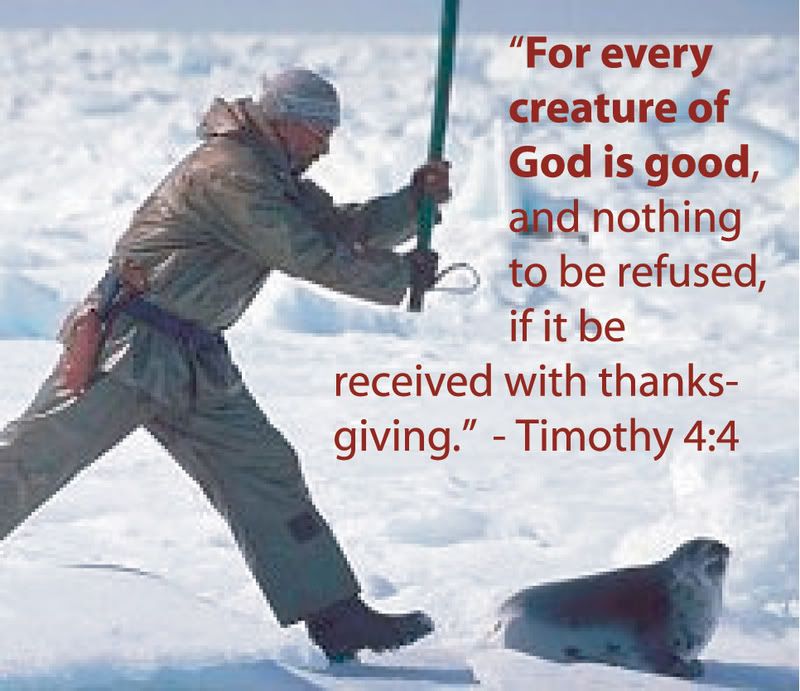
In that case, get used to scenes like this on your Christian calanders:


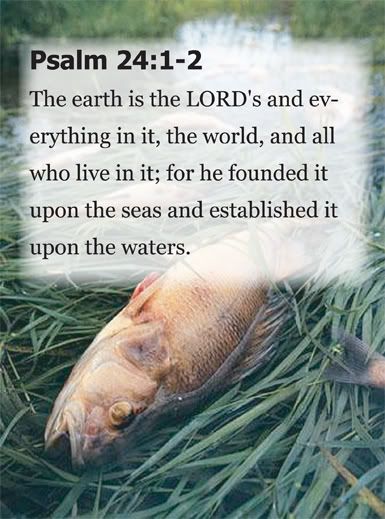
And can you imagine getting a greeting card with this on it:


Now that's compassion and mercy for God's creatures.

Sorry, what was that about dominion over all living things?


I made these graphics half in jest, but more to get people to think about the policies they support.

It seems to me that if you truly care about God's creation, and our place in it, then you would be careful when you value the Almighty Dollar over Him. Because that's what it comes down to - using the creation as a means to an end (wealth) is downright sinful.

Luckily there are more and more Christians converting to the side of good stewardship of the Earth.


- - - - -

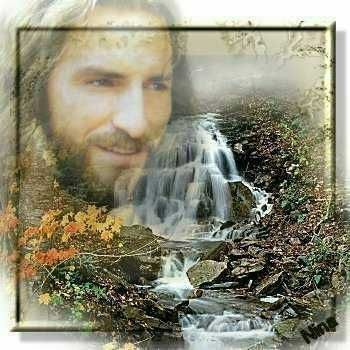
That first picture I posted, way up at the top, speaks to me more than those initial images I had in my youth of a city in the sky as the rightful place of heaven.

I agree with Erik Reece, who - in his "Jesus Without the Miracles: Thomas Jefferson's Bible and the Gospel of Thomas" (originally printed in the Dec. 2005 Harper's - go here to read it, it's great) - says that a vision of of the Earth as merely a log in the stove of industry is a shameful way to behave:

"As the world all around us sickens and dies from the poi-son discharges of Hamiltonian industry, these twin gospels suggest that it is time we inverted Pascal's famous wager to say not that we should believe in heaven because we have nothing to lose but rather that we should believe first in this world, because in losing it we may lose everything. And if we can somehow live justly, modestly, with generosity and compassion, we have everything to gain."


Reece's idea that pulling heaven out of the sky and placing here on Earth fits nicely with Thomas Jefferson's dream of an agrarian, utopian America - "where farmers intuit the will" of the Creator from the laws of nature.

"Perhaps we won't have to wait for the kingdom of God," Reece writes.

But what will happen to it in the meantime?


Thursday, March 23, 2006

Doomsayer's Lament: On Peak Oil

Ever heard of "peak oil?"

I just learned about it, and boy-oh-boy - what a downer to my day.

"Peak Oil" is a state where oil production reaches its max, and demand starts to exceed supply. It would be the end of the world as we know it, and we'd be out of gas.

Think $2.40/gallon is a lot to pay? Think about $5. Or $10. Think about how much our lives are wrapped around oil and gas and fossil fuels. Then think about how our whole lives would come crashing down if oil became scarce enough to initiate wars.

Oh wait, maybe it already has...

Fun web sites like Die Off are predicting global apocalypse, while even members of Congress are shouting from the soapbox.

Some folks, especially on the West Coast, are getting ready by planting gardens, walking to work, and installing solar panels on their rooves. When I first started reading about peak oil, a lot of it sounded like Nuclear Winter fall-out shelters and canned food stockpiles in your crazy neighbor's basement.

But then I think about what happened after September 11, when the gas prices spiked and people lined up for miles at the gas station. Or when Katrina struck and gas topped $3/gallon. It doesn't seem to take much to make us jittery.

Some experts say it would take us 10 or 20 years just to get ready for this scenerio - to ween ourselves from oil, restructure our whole way of life, and start planting Victory Gardens - while some say we've already hit peak oil and are on the downward slide.

Makes that Prius look not-so-dorky now, doesn't it?

Who knows? Who can tell for sure? Maybe it's just a bunch of wackos, viewing the first cracks in a falling sky.

But maybe we ought to prepare ourselves for No More Oil - just in case. Maybe I ought to take my Route 66 trip a little sooner than May.

Maybe I should learn how to plant tomatoes.