
I used to watch a decent amount of TV. I'd get up in the morning and watch CNN while eating breakfast, come home and catch the news, and maybe grab an episode of "The Simpsons" with Don. Now I can honestly say I watch maybe a half hour to an hour of TV of week. I don't watch a lot of TV now, but I used to.
But that got me thinking: what do I do with my time now?
I only have to look at the hand prints on my iBook to know what I do. I'm on the computer constantly, either writing blog posts like this one, or that one, or researching trips and trip ideas, or doing tons and tons of reading, or I'm actually inside the computer trying out DIY projects and living to tell about them.
And I'm not alone. People are watching less TV these days, and finding far more productive uses of their time. Just like me.
In fact, I feel like I'm busier nowadays than I ever was when I was in tons of organizations and zooming off to meeting every night and spending a ton of weekends in Adrian. Now, I look back on that time and wonder, "How the heck did I manage?" I guess I managed by spending my time differently. It's no better or worse than before.
Now, though, I actually look down on people who watch a ton of TV. "Jesus," I catch myself thinking, "don't they have anything better to do?" It's not very fair. Television can have its redeeming qualities. But to me, the real world happens outside of that glowing box. Maybe I've said this before?
The change began, I think, when I first discovered MySpace in the spring of 2005. It became my cognitive heat sink. I read the vast amount of blog posts from back when I first discovered MySpace and - again - I wonder where I had all that free time. My political and social and personal thinking was all there, out for everyone to see, and now I'm lucky to post something new to MySpace once a week. I don't post to MySpace so much these days, but I used to.
Part of it is that, while I'm not involved in so many things as a whole, I'm deeply involved in the organizations I participate in. It seems my to-do list for my recycling group is never ending. But what could be a better cause? My political and environmental passions both get stoked, and I'm doing what I love. Same with Rotary.
So all that time I spend watching TV - wasted time, when you get down to it - I'm busy doing something else. Not to say that watching TV is a bad thing. I still adore my "The Office" episodes, and football on Saturday, and watching "Wheel of Fortune" with grandma. But the news? I listen to NPR religiously on the way to and from work. Or I read it online. And trust me: I'm reading or listening to the smarter news these days.
After that, I'm busy taking walks or going for a bike ride or undertaking whatever "wouldn't it be fun if..." project that shapes and grows my brain a little bit. It's been a blast. What's more, you'll never hear me utter the words, "I'm bored." Never.
Because I'm never bored these days. But I used to be.
Showing posts with label DIY. Show all posts
Showing posts with label DIY. Show all posts
Thursday, July 31, 2008


Sunday, March 2, 2008
Sunday Project: setting up AirPort on an iBook G3
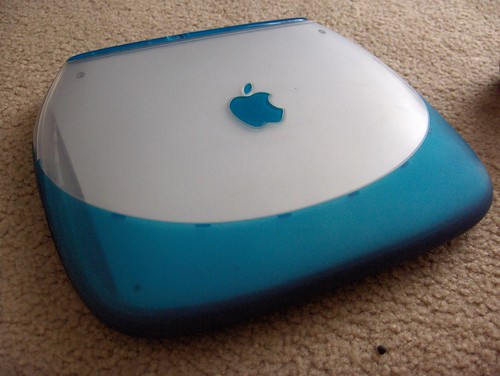
I love my G3 iBook. I bought it right before my Route 66 trip because (a) I was nervous about taking my then-new G4 and (b) the thing is built for road-warriors and students. It's the toughest laptop I've ever seen, and I knew if I took it all the way across the country, it would survive in a pinch.
And it did, both on the Route trip and the Seattle trip. But one drawback was its lack of wireless connectivity. I underestimated the number of hotels - even run-down ones - that have wireless internet these days. One night, in Needles, California, I drove to three different hotels looking for an ethernet connection, never finding one (which is one reason why the Route updates didn't come as often as I wanted).
Now that's all over with. I grabbed an AirPort card off eBay for a reasonable price, and took today to actually install the thing.
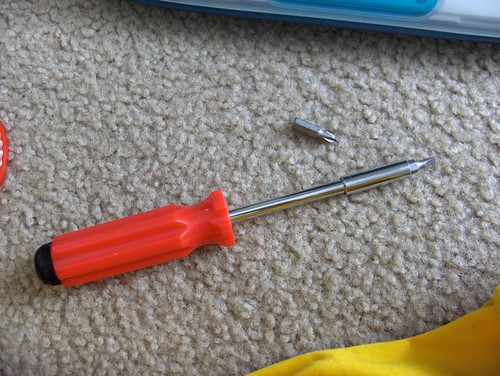
Thetools were simple: a flathead and Phillips screwdriver head, the smaller the better. Also, I grabbed instructions of the Apple.com support site.
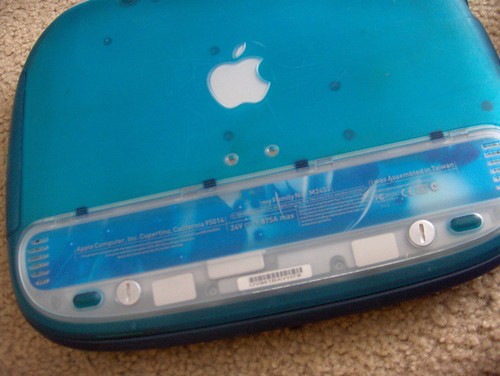
The first step was to remove the battery. No sense in getting shocked. On modern Apple laptops, the battery is super easy to remove. Turn the thing over...
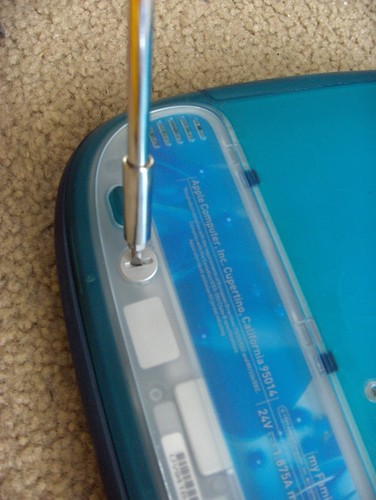
The two giant silver screws take one-half twist to remove. Take the cover off, and grab the plastic handle attached to the battery:
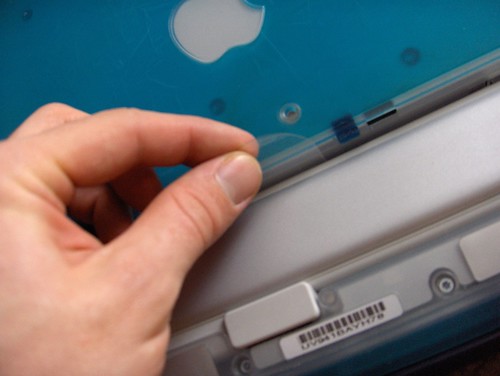
The battery slides right out. Mine looks like it was a replacement model from 2004, but already it looses charge faster than it should. Looks like I'll have to shop for a new one.

Now that the risk of electric shock is gone, time to get some real work done.
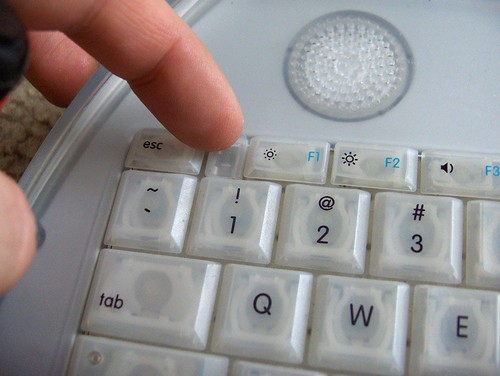
Toget to the iBook's guts, you have to take the keyboard off. Simple enough: slide the latches toward you, and the keyboard slides right out:
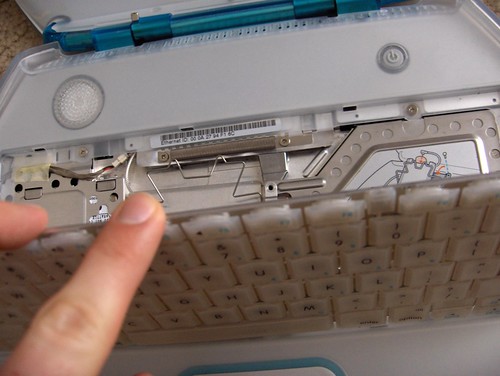
It'sa good thing I only want to install the AirPort card, because replacing anything else (like the hard drive, for instance) would be a nightmare. There are screws everywhere. Luckily, the AirPort holster was held in place by only one screw, which means someone had already installed one and taken it out (the previous owner, probably). Anyway, unscrew however many screws there are:
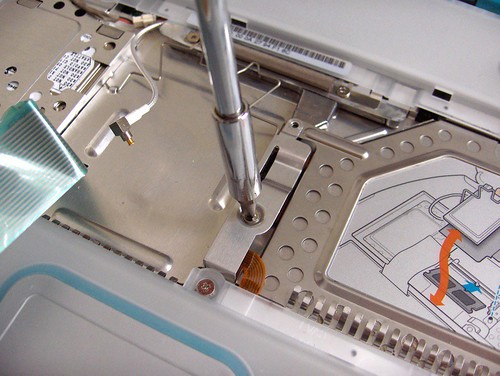
And slide the holster right out:

The wireless antenna was easy to find - it was the only cord not attached to something. It plugs right into the top of the AirPort card:

Getting the card into the holster was tricky, because it doesn't really hold the AirPort card in place. Instead, the card slides into the top of the palm rest, right above the trackpad:
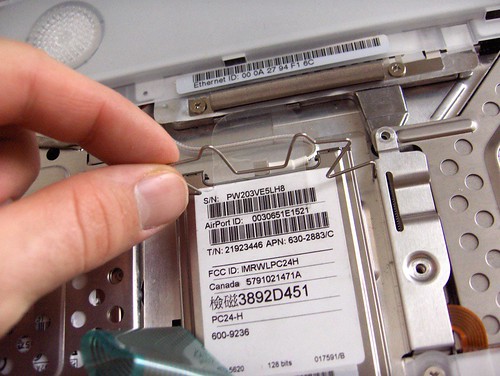
Then the antenna requires that you loop it around the top of the card, so everything lays flat:
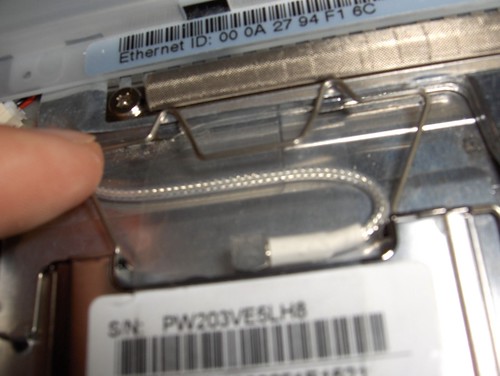
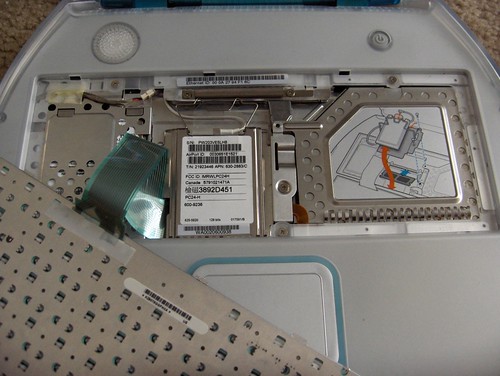
Booya - an installed wireless card. One screw to lock the holster in place, put the keyboard back on, lock the keyboard latches, and turn the puppy on.
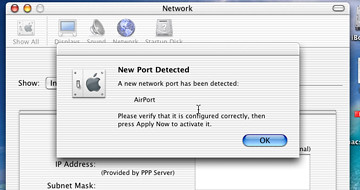
Apple makes it super easy to set up the software side of things. Under "System Preferences" and "Network," OS X automatically detects the new card. Just tell it what your wireless station is called (mine is called, simple, "AirPort" because I have an Extreme Base Station).

Recognizing my base station was no problem, but when I put in the password, it wouldn't connect. After doing some research, I found I had to scale back the security because this AirPort was an older version - 802.11b.
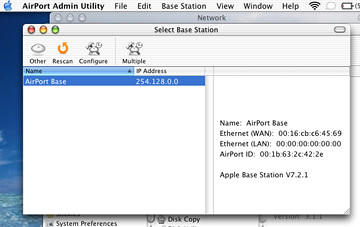
After that, bam - everything ran smoothly. The AirPort card recognized my wireless station (as well as all my neighbors) and connected at full power.
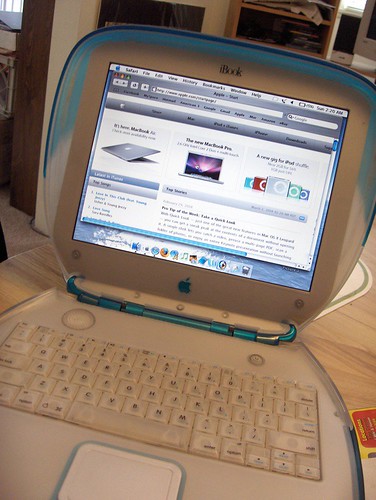
And look at that. No wires. Full-speed internet. It zipped right along, and the only thing holding back loading time was the speed of the computer (it's 300 Mhz - pretty slow by today's standards).
But it works, and it took me about 15 minutes to set up. Now when I take my road-worthy iBook to New England, I can connect any way I want.
Now if I was only brave enough to update the RAM in this screw-heavy beast...
Sunday, November 11, 2007
On making bread.
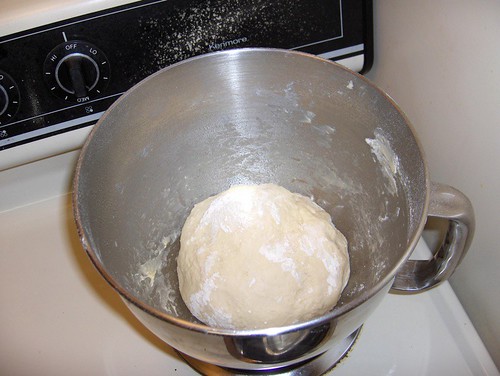
It's a magical thing, to make your first loaf of bread.
After reading about how easy it is, I couldn't help myself. Making my own home-made loaf of bread would be this weekend's project.
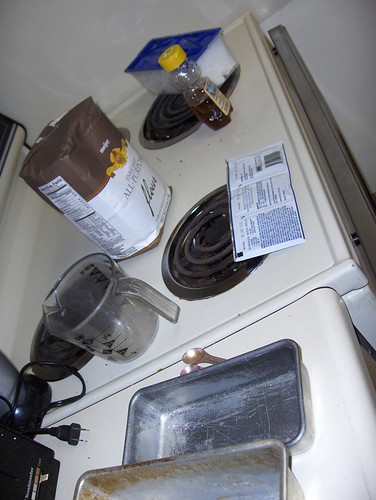
I followed the recipe's directions to the T, with a few left-turns here and there. For instance, I used a bit of brown sugar and some honey in place of the five teaspoons of plain sugar. Also, I found downing several cups of coffee in the process helps the mind focus on step-by-step instructions.
The recipe ended up making two more loaves than I was expecting, but that gave me the chance to give one away as a present and to take one to work tomorrow for lunch.
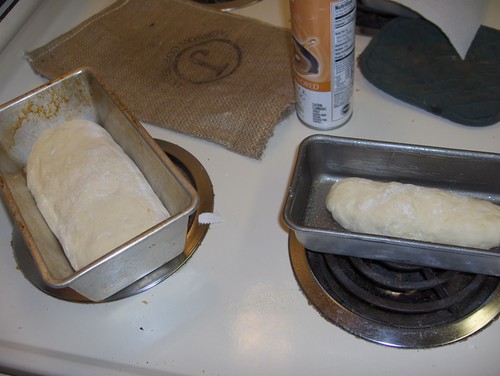
Watching the dough rise is an amazing process, but not a new one for me. After all, watching a giant metal bowl mix an entire bag of flour at Hometown while making pizza dough was all the experience I really needed. The yeast-y smell, the sticky dough - it brought back a lot of memories.
Letting the dough sit also gave me time to tackle other projects around the apartment, and listen to "A Prairie Home Companion."

But at the end, it was a beautiful finished product. And, together with the homemade chicken noodle soup I made for Thursday's dinner party, it made for a heckuva dinner.
Now I have all kinds of ideas about the type of bread I'd like to make. I'm a wheat/grain kind of guy, so I'd like to add some more fiber and flavors to the mix. Also, maybe try some dessert-style loaves.
It ended up being a fun, lazy-Sunday project. I always seem to have more time for cooking in the winter (and maybe more of an appetite, too), so I can imagine making more with a big pot of chili or something.
In the meantime, it's another check on my always-wanted-to-do list.
Friday, November 2, 2007
Nov. 1, 2007: Newton syncs with iMac
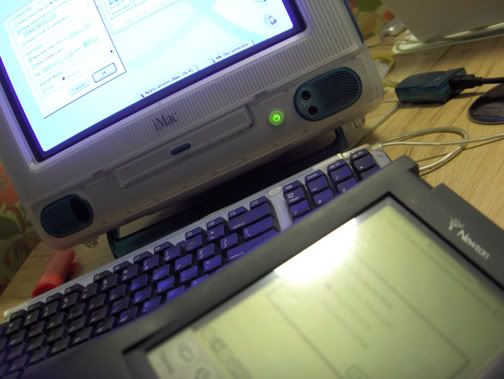
Sometimes, geek dreams really do come true.
First, some background: I bought an Apple Newton - the first PDA ever invented - almost a year ago, just to play around with it. Unfortunately, I haven't been able to sync it to my Macs. The Newton uses an old serial cable that no one uses anymore.
Then I found a serial-to-USB adapter, but then the Newton's batteries ran dead, with no hope of recharge. So I bought some Sanyo Eneloop pre-charged batteries, and have finally been having some fun with the MessagePad 110.
And for the past few days, I've dug the adapter out and tried syncing it with my laptop and my iMac - with no luck. Then, tonight...
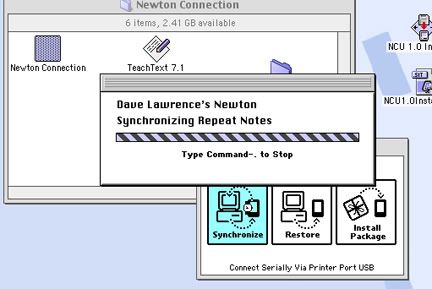
Whala. There it was.
The technical stuff is a little complicated, but long-story-short, I messed around with the hookup settings late tonight and finally, my Newton and iMac are talking.
It's a shame I have to use OS 9 to do everything (my iBook doesn't like the adapter), but now I can do anything, like add events to my Newton calender:
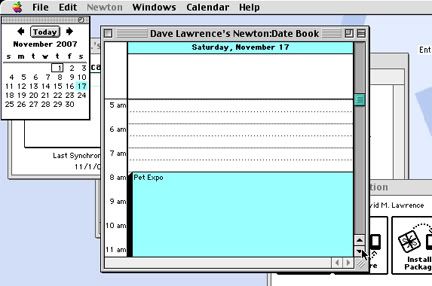
Or names and contact info to my address book:
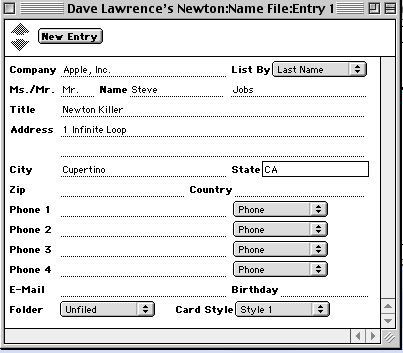
But the point is, now I have my circa-1993, pre-iPhone organizer up and running:
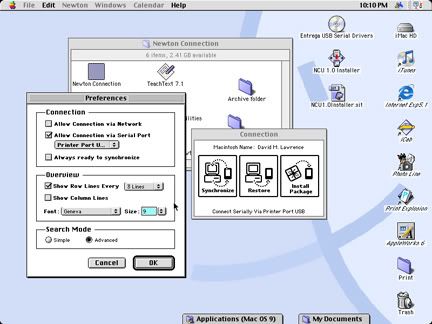
Now, what to do with it?
That's almost a non-issue. The point is, I got it running, and can control it with other means rather than the handwriting recognition software.
Who needs an iPhone?*
*Last sentence was a joke, totally not serious, made by author who was up too late working on his dorky, obsolete pet project while dreaming of midgets in rainbow jumpsuits doings lines of coke off iPod Nanos. Disregard. Carry on.
Monday, August 20, 2007
Running fool.

Let me tell you about running intervals: they're a pain.
I've learned this during week five of the "Cool Running Couch-to-5k" program. I did fine during week one, where I ran 60 seconds and walked 90 seconds. It was the next week, week two, where it got harder. Then it was 60 sec/run, 90 sec/run, and it hurt. The next few weeks were better, but last week was the worst: 3 min/run, walk, 5 min/run, walk. Ugh.
I just got done with the first run of week five, thanks to Robert Ullrey's brilliant podcast. Maybe this cool, rainy weather helped, but my 5 min/run, 3 min/walk intervals weren't that bad. And it timed just perfectly to make a complete circuit around Ella Sharp Park.
The running has been great. I've run in the heat, in the cool evenings, and now when it's raining. I've run down West Ave. and Fourth St. and around Essex Heights and a few laps through Cascades Park. I've seen deer and woodchucks, almost been attacked by a few cranes, and seen my first Jackson-born black squirrel.
I can feel my legs and my breathing change, too. It's hard to imagine, at week one, running for five straight minutes. But this is the second week I've done that, and those 60-second intervals during the initial phases seem like a cakewalk.
Using a bit of mindfulness, I've made it easier to overcome the longer intervals - especially the new 5-minute ones. I concentrate on my arms for a while, then on the way my feet are hitting the ground, then the awful pain my calves are experiences, and - as always - my breath. I ran short-distance track in high school, and never have I been comfortable running for 5 straight minutes.
Now I am. Amazing.
Andrea says the techno music helps her zone out, but I think just running around the neighborhood is doing fine for me.
This week is interesting, broken up into three days of different workouts: there's today's 5-minute intervals, but next is 5 min. and 8 min. intervals. You know, the kind I was complaining about above. The last day there's a straight 20-minute run.
I'll let you know if I survive.
Tuesday, August 14, 2007
Thirsting for plastic.

Water is expensive.
This according to a New York Times column (Aug. 1, 2007) that pointed out if you got your eight glasses a day from bottled water, you could spend $1,400 every year. Compare that with the $0.49 it would cost from plain old tap water.
Consider this: all that plastic costs barrels of oil. All those bottles cost money and CO2 to ship cross-country. Only 23 percent of bottles are recycled, and states like Michigan don't offer a deposit as an incentive.
Recycling Jackson has reported on the thirst (pun intended) for recyclable plastics: companies can't collect enough used plastic bottles, even though the demand is high. Companies are willing to pay decent money for someone's used Aquafina (which is tap water anyway) bottle.
Plastic bags, however, are a totally different story. They're a pain in the ass, according to a Salon.com story about the difficulties of recycling the jelly-fish like bags:
"Every year, Americans throw away some 100 billion plastic bags after they've been used to transport a prescription home from the drugstore or a quart of milk from the grocery store. It's equivalent to dumping nearly 12 million barrels of oil," writes Katharine Mieszkowski.
Only one percent of those are recycled.
Some have said plastic is better than paper, but you can't grow more oil like you can more trees. "The only salient answer to paper or plastic is neither," says the article.
When I attended a Mariner's game during a recent Seattle, WA trip, I noticed that everywhere I looked there were bins for recycling plastic pop, juice, water, and - yes - beer bottles. And when the game was over (they lost to Texas by one point), the announcer even reminded the audience about the recycling bins.
What do Seattle Mariner fans know that we don't?
I'll admit: I'm a fan of bottled water. It tastes good, it's portable, and I can make a health and wellness justification when I bypass the sugared soda pop for a liter of the clear stuff.
But paying $1 or more for a bottle of the same stuff I flush in my toilet seems absurd, doesn't it? This is the same stuff I use to clean my dishes, wash my car, and brush my teeth. And it's still the safest and cleanest in the world. Some parched countries in the Sahara would give a lot for a teaspoon full of what I watch go down the drain every morning.
So recently I've started drinking plain tap water. And you know what? It's not that bad. I add a few drops of lemon juice if I don't like the taste, plop in a few ice cubes, and away I go. I'm not any less satisfied. My thirst is just as quenched, and I didn't contribute any more plastic molecules that will be around longer than the cockroach.
The critique is two-fold, involving both the use and waste of plastics and the mania behind obtaining fresh water from somewhere besides the garden hose. The more you think about it the more ridiculous it seems.
All that craziness has me thirsty. Time to grab a glass of cool, clear...
Well, you know the rest.
Monday, July 30, 2007
eJunkies anonymous.

I've made a big step in my life. One that has involved plenty of thoughtful analysis and probing soul-searching. It's nothing to be taken lightly. I have to do what's best for me.
I purchased compact fluorescent light bulbs.
Because I have to do what's best for the environment, too, and when I learned that most of a incandescent bulb's energy is lost to heat - and how I could save money on my electric bill - it just made sense. It's not often you'll get a household item that will pay for itself over time.
The deep, deep discount on Amazon.com ($4.99 for four bulbs) helped a lot, too.
So now when I turn on the lights at home I know I'll be helping the environment, saving on my energy costs, and reducing my impact on Global Warming - literally. Have you ever felt a lightbulb when it's on?
I think something clicked in my brain back when we learned about recycling and Earth Day in school. All that planting trees and three-Rs just made sense. Why waste?
Katie also handed me her old cell phone to recycling (or sell on eBay - we haven't decided yet), so I sent an e-mail out at work asking for anyone's old phone so I could take it to our recycling site. I also bought and distributed recycling bins around the office - especially near the copy and fax machines - so we can reduce our paper waste.
The funny thing is all this doesn't take much work. A few half-hours a week, and you can make a little bitty impact.
Considering we're all making a great big impact on the world at large - did you know the plastic we create will never go away? - it's shameful to think some people don't do anything.
It might be that I dig the warm, squishy feeling I get when I do something like e-cycle cell phones or batteries that would have otherwise ended up in the trash. I don't look for any recognition or thanks, but it always helps when people play along.
At work, when I asked for paper grocery bags to store all our to-be-recycled paper (it makes it easier to just toss the whole thing in the recycling bin), my coworkers came through in spades.
And after I sent out the e-mail, one coworker came up and gave me a cell phone she put in her desk. She didn't know what to do with it.
Little things like leaving lights on when no one's in the room, or throwing away a blank sheet of paper and not using it for scrap, or buying those stupid disposable mops that Swiffer is so proud of - it drives. Me. Crazy.
But I'm not interested in changing everyone's mind. It's impossible. I remember Dr. Renner picking on me in the newspaper office, saying he was going to crown me "resource managment czar" because I was such a pain about reusing paper and turning off lights. And this coming from a professor who would burn through reams of paper like a junkie with pharmacy keys.
Instead, I'll quietly go about doing my own thing - like those fancy new lightbulbs - and wait for the rest of the world to come to its senses.
Wednesday, September 28, 2005
The future belongs to those willing to get their hands dirty
Back in mid August, I had tickets to a Detroit Tigers baseball game. The tickets came courtesy of work – good, behind-home-plate seats – and I spoiled a few friends by taking them along. A good summer evening to enjoy a game and some friendly fellowship.
After the game, when the four of us piled into my car to head home, my car wouldn’t start. In downtown
It had always been one of my worst fears – to be stuck in downtown D-town. And as often as I go there, it was an ever-present fear. It’s why I bought a cell phone.
We were messing with the car, when down the street walks Carl. Carl asked us to try and start the car, fiddled around with some connection cables to my battery, and diagnosed the problem. “Do you have a flat-head screwdriver?” he asked. I did, in my toolkit in the drunk. He stuck the flat-head in a slot near my battery. He told us to start the car.
It rumbled to life like nothing ever happened.
All of us rode most of the way home in stunned silence. Here comes Carl, Jesus in disguise, and after only listening to my car (and perhaps consulting some long-deceased auto god), knew what was wrong. But here were four college students. Why couldn’t we figure out the problem? We had four bachelor’s and one and a half master’s degrees between us, and we were impotent.
What was our problem?
- - - - -
Garrison Keillor wrote a column on Salon.com today about his mother canning vegetables during his childhood, pressure cooker steaming and glass jars filled with foodstuff to get the family through the winter. He also wrote about his father, stooped over the engine block of the family Ford, fiddling with this and that. Keillor ignored the skills his parents could’ve passed on to become a writer (and radio host). But those handy skills can come in…well…handy, especially when civilization starts to break down, or even if all you can depend on for survival is your two hands.
“Beware of losing basic skills,” Keillor writes. “Hang on to that pressure cooker.”
I remember my own grandmother, steeped in the traditions of her home states of
And I also remember my father working on cars and trucks – especially my own. I’ve never had a new, or even semi-new, vehicle in my life. As a teenager, my cars would need constant repair. Instead of taking it to a mechanic or dealer, my dad would take it to his friend Scott’s, and together they would work out whatever was wrong with it. My dad always encouraged me to watch – “You might learn something,” he told me; none of what I saw stuck. I’m car illiterate; always have been.
In fact, much like Keillor, my mind was built for more artistic passions. I did well in school, I was active in my community, and I worked all through my teenage years. But I never learned such essential and elementary tasks as changing my own oil. Or changing a tire.
Confession: I’ve never changed my own tire, and am scared I don’t know how.
I got another wake-up call last night, on the way to the bar with friends. My driver-side headlight seemed dimmer than the passenger-side light. My first thought: I have a headlight out. My second thought: I don’t know how to change a headlight.
(My third thought: I hope we don’t get pulled over on the way home)
That, combined with Keillor’s article, got me thinking about what skills I do possess. I can cook. I can put simple things together with my meager tool set. I can play guitar. I can design graphically. I can write.
But if I were to crash-land on a desert island somewhere, would I have the skill required to survive for more than a week or so?
Probably not.
- - - - -
I have a deep-held respect for DIY people. My grandmother can garden. My uncle can make his own wine. My grandfather could put together bikes from scraps he bought at yard sales and sell the complete bike in his front yard for profit.
One acquires the necessary skills to survive over the course of ones life, I figure. Eventually, my car will have broken down so many times that I’ll have a mental encyclopedia of all that could go wrong with a post-1981 American-made car. Right?
Keillor’s right. In a sort of anti-yesterday’s-post vision, I came to realize that the skills of our previous generations are slowly being lost. We can’t even remember the phone numbers of our best friends – our cell phones remember them for us. Should the world go to shit, I think the mechanics, the janitors, the country cooks, and the hunters of this world won’t have too much to worry about.
The rest of us? We’d be in our own pressure cooker – struggling to think of all our parents and grandparents had taught us that we either ignored or forgot.
Subscribe to:
Posts (Atom)


