Friday, August 17, 2007

Jackson's 30 under 30.


Just a quick congrats to my buddy Suzanne McCloskey, who was named one of the "30 under 30" in this month's Jackson Magazine.

I think the magazine doesn't like me much, after working there and then...mysteriously...not working there. But whatever.

A big fat congrats to Suzie-Q.

Thursday, August 16, 2007

Like everything else, it's completely inane.


There's something about the end of the world that I look forward to.

With so much going on in the world, not to mention the meltdown of everyone's spending power, it's hard to feel sunny on warm August days like today.

All this, coupled with the Minnesota bridge collapse, speaks to the impermanent nature of...well...just about everything, right? When it comes right down to it, you can't predict what's going to happen in life, let alone your own little sphere of existence.

In which case, send flowers. Someone out there could sure use them.

Tuesday, August 14, 2007

Thirsting for plastic.


Water is expensive.

This according to a New York Times column (Aug. 1, 2007) that pointed out if you got your eight glasses a day from bottled water, you could spend $1,400 every year. Compare that with the $0.49 it would cost from plain old tap water.

Consider this: all that plastic costs barrels of oil. All those bottles cost money and CO2 to ship cross-country. Only 23 percent of bottles are recycled, and states like Michigan don't offer a deposit as an incentive.

Recycling Jackson has reported on the thirst (pun intended) for recyclable plastics: companies can't collect enough used plastic bottles, even though the demand is high. Companies are willing to pay decent money for someone's used Aquafina (which is tap water anyway) bottle.

Plastic bags, however, are a totally different story. They're a pain in the ass, according to a Salon.com story about the difficulties of recycling the jelly-fish like bags:

"Every year, Americans throw away some 100 billion plastic bags after they've been used to transport a prescription home from the drugstore or a quart of milk from the grocery store. It's equivalent to dumping nearly 12 million barrels of oil," writes Katharine Mieszkowski.


Only one percent of those are recycled.

Some have said plastic is better than paper, but you can't grow more oil like you can more trees. "The only salient answer to paper or plastic is neither," says the article.

When I attended a Mariner's game during a recent Seattle, WA trip, I noticed that everywhere I looked there were bins for recycling plastic pop, juice, water, and - yes - beer bottles. And when the game was over (they lost to Texas by one point), the announcer even reminded the audience about the recycling bins.

What do Seattle Mariner fans know that we don't?

I'll admit: I'm a fan of bottled water. It tastes good, it's portable, and I can make a health and wellness justification when I bypass the sugared soda pop for a liter of the clear stuff.

But paying $1 or more for a bottle of the same stuff I flush in my toilet seems absurd, doesn't it? This is the same stuff I use to clean my dishes, wash my car, and brush my teeth. And it's still the safest and cleanest in the world. Some parched countries in the Sahara would give a lot for a teaspoon full of what I watch go down the drain every morning.

So recently I've started drinking plain tap water. And you know what? It's not that bad. I add a few drops of lemon juice if I don't like the taste, plop in a few ice cubes, and away I go. I'm not any less satisfied. My thirst is just as quenched, and I didn't contribute any more plastic molecules that will be around longer than the cockroach.

The critique is two-fold, involving both the use and waste of plastics and the mania behind obtaining fresh water from somewhere besides the garden hose. The more you think about it the more ridiculous it seems.

All that craziness has me thirsty. Time to grab a glass of cool, clear...

Well, you know the rest.

Thursday, August 9, 2007

If I had a million dollars.


Let's say you play the lottery this weekend, and win $50 million.

Now what?

A post on Consumerist.com got me thinking about what I would do if I ever hit it big. Now, first of all, it's a rare day when I step into a store and buy a lotto ticket. Usually my grandma has to tell me what the jackpot is, and I'll mosey in and grab one. But then I forget about the drawing, and don't even check my ticket until weeks later.

I think we've all had those "what if" moments, right? Some folks I know even have every last dollar spent, before it even hits their hand. Now that's wishful thinking.

The typical response includes - and I'm just guessing - paying off debt, buying parents a house/car, buying self a house/car, traveling, and investing. Those are pretty standard responses.

But the funny thing is, that almost never happens. Those of us halfway decently educated on financial matters aren't the ones playing the lottery; we know what the odds are, after all, and wouldn't be caught dead using Power Ball as an investment tool.

Everyone, I'd bet, has that fleeting sense of euphoria when they buy the ticket that could win $140 million, though. "Wouldn't it be nice?" we ask ourselves, knowing full-well we're living in fantasy. Unicorns will spring, full-grown, out of my butt as I get struck by lightning. Then I'll win the lotto.

Tons of neurons have wastefully fired on this subject. So - just for fun - we'll fire some of our own. Ready?

Let's say, by picking the numbers 8, 12, 16, 21, and 27, you hit the jackpot and win $13 million - a modest sum, perhaps, but a better chance than winning anything over $100 million.

Now there's a choice: take payments (about $312k/year, after taxes) or take a lump sum (about $5 million after taxes - calculated here). Either way, with a $300,000 annual income or as the new recipient of a cool five mil, you're sitting pretty well off.

Conventional wisdom holds that the lump sum is the smarter choice, because you - as an investor - can better manage your money and help it grow over time. So let's figure $5 million as the payout, after taxes, and after they give you the big cardboard check and take pictures, you're on your own.

There are actually companies out there that do nothing other than cash-out annuities. I listened to an interview with a guy on "This American Life" who started with one of those companies, and the misery and desperation he saw broke his heart. Lotto winners usually end up spending all their money before they even get it, so this guy's company would swoop in to the "rescue" and buy out the winner's remaining funds.

Well, in the case of our thought experiment, we ignore those bastards. Because the first thing we're going to look into is some kind of trust or LLC that could give us protection from taxes. And frankly, a little time to cool off wouldn't hurt. We'll say a month or two. It's not that long to wait.

Now, we've got $5 million sitting in the bank. If we just left that money alone, at a modest rate of return - say, 5% - we could earn $250,000 a year. Which is actually less than we'd receive if we took the payment schedule from the state lottery association. So we won't do that.

Instead, let's do some good with our new found wealth. First, we think of family.

My dad's house ($150,000) would be paid for. And a car or truck for him and his girlfriend ($40,000). My sister would get a modest house and car ($150,000). My grandma's house would be paid for, and she'd get a new car and a new garage door ($166,784 - we'll round to $170,000).

That's $510,000 spent, about $4.5 million left over. What's next?

Debt. My car ($6,000), my student loans (about $17,000), and a few things here and there ($5,000). Plus my roommates debt (unknown, but we'll say $2,000) and a new car for him ($20,000). Katie gets a new car, too ($25,000).

That's $75,000, or $585,000 all together. Not too shabby. We're still left with $4.4 million.

Next we'll say a new house in a decent neighborhood, but nothing too fancy. About $250,000 should do us. Plus a BMW of some sort ($50,000), a boat ($20,000), and a Mac Pro with 30-inch Cinema Display and Adobe Creative Suite 3 ($4,000).

That's $324,000, or $909,000 all together. We'll round that up to a million, just to be safe, leaving us with $4 million.

Now the Bible says to give 10% off the top of your income to tithe. If I start with my original winnings, that would be about $500,000. We'll double that. I would donate, flat-out, $100,000 each to the Juvenile Diabetes Association, the Interfaith Homeless Shelter here in Jackson, a west-coast environment group (here, here, and here, perhaps), the Rotary Foundation, and an organization I would set up myself to help get people out of hard times. Maybe we'd call it the "You're in trouble, so here's $1,000" fund. With few questions asked.

With the half-million left over for charity, I'd do something huge. I'm not sure what, but it would be in the style of the Carnegie Library project. Something that has value, and lasting impact, on small towns all across the country. I'm thinking internet-ready Macs in the hands of inner city school kids, or a cure for diabetes, or kids-themed, hands-on science museums in small farm towns, or a non-profit veterans health center - fully funded, unlike our current government - that gives needed health and psychological aid to our soldiers. These are just off the top of my head.

Now there's $3 million left. For kicks, let's put a million dollars into travel, take a year off, and go see the world. The whole thing - all seven continents, and the big islands. Months in Europe, and India, and a week or two in the Canadian Rockies wilderness, living in a cabin and eating off the elk I'd kill with sticks and rocks and my two bare hands. I'd stop moving when the money ran out.

Exhausted, I'd put away the rest of the $2 million and live off a steady interest. Even earning a modest 5% in some internet savings account, I could make $100,000 a year, which is more than enough. But if I invested aggressively - say, at 10% - I could live off the $200k/year.

Until I'm dead.

In the meantime, I'm sure I'd give plenty of money to my fraternity and maybe to Adrian, if they'd ever get their act together. But I'd do it anonymously, because nothing ticks me off more than those giant cardboard checks and someone's name slapped on the side of a building. If you're going to give, to it for the right reasons.

All of this is dreaming, of course, but I think a plan always helps - you know, just in case. A plan for everything, in fact, because there could come a time when you have to make some split-second decisions. As methodical as I am, I'd have to do it right.

Now give me a fortune cookie: I need some numbers to play...


----------------
Now playing: Milow - Waking Up
http://foxytunes.com/artist/milow/track/waking+up

Shiny and new.


How slick is that?

It's the new iMac, a slight overhaul of the G5 design - and boy is it pretty.

The metal only makes sense: with the Mac Pro, Mac Mini, iPod shuffles and nanos, and Macbook Pros, the aluminum seems to be the new standard.

I like the white, personally. It's served Apple well since the iMac G4 (my favorite), and it looks spiffy on my iBook.

When I'm ready to grab a desktop system, this will be it.

Wednesday, August 8, 2007

On hard work.


I can understand why Garrison Keillor, for some time now my philosopher of choice, balked at the fact that over 90% of our generation wants a job with creativity and allows them to make an impact in the world.

"All I can say is, Wow. Good luck. And now you know why we need illegal immigrants to do the inflexible uncreative stuff that simply needs doing right now. We've raised a generation of young people who want to be writers."


He's speaking, of coures, to you and me: the ones with at least some college experience, the ones raised on the rise of the tech and blog and PR money-makers that also start their own world-changing charities.

What a change, says Keillor, of the old days when digging a ditch was honest work. It's funny that my grandparents told me I wasn't going to be a ditch-digger - like it was something to be avoided. Now I find myself in a ditchless working environment, and you know what? I kind of like digging ditches.

"My father was a carpenter and a postal worker," Keillor writes. "He admired people who came early and stuck with a job until it got done. People who embraced work. His Republicanism was based solidly on that old bootstrap philosophy. Finish your coffee and get to work and let's get this hole dug and don't complain about the heat, it's the same heat for everybody. Stick with the job, rest as you need to, then resume."

My dad, too, worked hard for what he has. As a blue-collar tool and die worker, he got up every morning at 4 a.m., drove over and hour to work, and came home late to a half-cold dinner - only to fall asleep in his chair while watching "Lethal Weapon." On weekends he would mow the lawn (before he showed me how), drink some beers, and go out on his boat. These days he owns his own business, remodeling and repainting lake-front homes in Brooklyn, and does pretty much the same thing.

You could say we have different skills - I'm his computer technician, after all - but I think I acquired some of that sweat-of-the-brow appreciation from him.

It's not like my job involves that much hard labor. At times I have to lift boxes of bottled water to take to events, or climb up a ladder to grab some popcorn or used computer monitors, and maybe start up a generator to work out cotton candy machine. But most of what I do involves showing people how to do formulas in Excel, or how to write the lead paragraph of a press release, or how to use the Z-index when designing a newspaper ad. My skills grow every day because I make it a point to constantly teach myself new things. Take HTML: what to other people seems like a mish-mash of unintelligble gibberish is to me an elegant web-page building language. I know what "a href=" represents because I've taught myself.

I understand that not everyone can be creative in their job, and I get how lucky I am to be doing what I love and what I was trained to do. But not everyone can be a graphic designer. Not everyone can craft newsletters or brochures out of thin air.

According to Keillor, most people want to do these things, and he sees them as seriously misguided people. And I agree. Sure, to some it's not as sexy to fix cars (although I do see the beauty in a classic Chevy tooling down the road), or clean toilets, or sell insurance. But these things need to be done. More and more we're relying on people with questionable backgrounds to do the tasks, as our President puts it, "Americans don't want to do."

Well to the hell with want. What needs to be done?

The Greeks had a helluva guy in Democritus, who got his hands dirty doing the experiments that have lead to our understanding of the world around us. But over time, guys like Democritus became rare. After a little something called the slave trade, Greeks (and, eventually, Romans) saw getting one's hands dirty as slave's work - and avoided it all together.

It's this societal arrogance that helped break the branch of Classical learning. Greek and Roman society rotted from within after they found some tasks below worth, fit only for chain gangs.

Like Keillor's father, and mine, I don't mind a day of hard work. There's something to be said about the hard work ethic; about digging a hole, or raking an elderly person's yard, or cleaning toilets. There's dignity and worth to these projects.

When I worked for the Michigan Department of Natural Resources, at Hayes State Park, the summer after my senior year, I learned first-hand the elegance of scrubbing a camp ground vault toilet. It wasn't pretty, and it didn't smell good, but it needed to be done - and that's what they paid me to do. Sometimes, to break the monotony, campers would shove all kinds of non-essentials down the commode for us to find.

I've often thought to myself that, if this whole writing and art stuff didn't pan out, I would be perfectly content with cleaning the office building of people who couldn't imagine doing the job. Shit, why not? There's something to be said for making something look and smell nicer than what you found it.

Some arts, like canning and gardening and mowing your own lawn, are being lost over time. Wouldn't it be a shame if all the wineries would destroyed in a freak accident, and no one knew how to make their own anymore?

There is nothing wrong with an honest day's labor. It's all work, all of it, and it needs to get done. I think our generation needs to accept this, and not be afraid to do it themselves. Embrace the DIY. You might find out something about yourself you never knew existed.

Maybe some day, you'll put that knowledge to good use. Doing dishes in a pizza joint taught me the benefits of a clean sink. Scrubbing sinks showed me what a pleasure Cascade and a sponge can be.

That's not old fashioned. That's living.


----------------
Now playing: Absinthe Blind - The Break (It's Been There All This Time)
http://foxytunes.com/artist/absinthe+blind/track/the+break+(it's+been+there+all+this+time)

Tuesday, August 7, 2007

Rocky Mountain High


Back from Colorado, tired but refreshed.

My love of the West grows with each trip: Route 66, Yellowstone, and now the San Luis Valley and Wolf Creek Pass, in the south-central section of the Rocky Mountain State.

Katie's family - her dad, her three brothers, her sister - were all so warm and welcoming. We didn't pay a thing for room, and spent pennies on food and gas.

There were sections of highway 12 where you could smell the state - what Colorado says to the senses, in its beauty and isolation and deep valleys. Last year I only drove through, stopping briefly to sleep in Grand Junction. But along the eastern front of the mountains, there's a mix of New Mexico, Montana, and outlaw country that I've never experienced before.

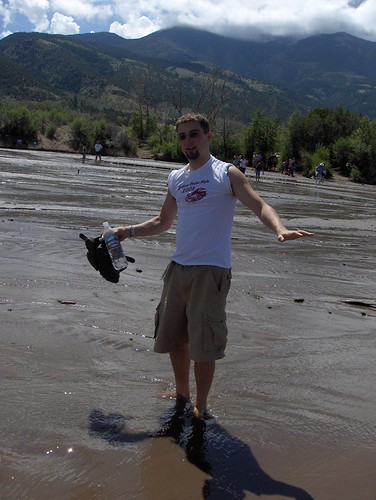
I took plenty of pictures, but they hardly do the tug of gravity any kind of sensible justice. Scaling death-inducing cliffs, or tasting a down-from-the-mountain stream, or scrambling up the tallest sand dunes in North America - it's a true sense of the American frontier spirit that I took home (with some beer stained clothes, granite, a newly designed web site, and a sunburn).

See you next time, Colorado.